
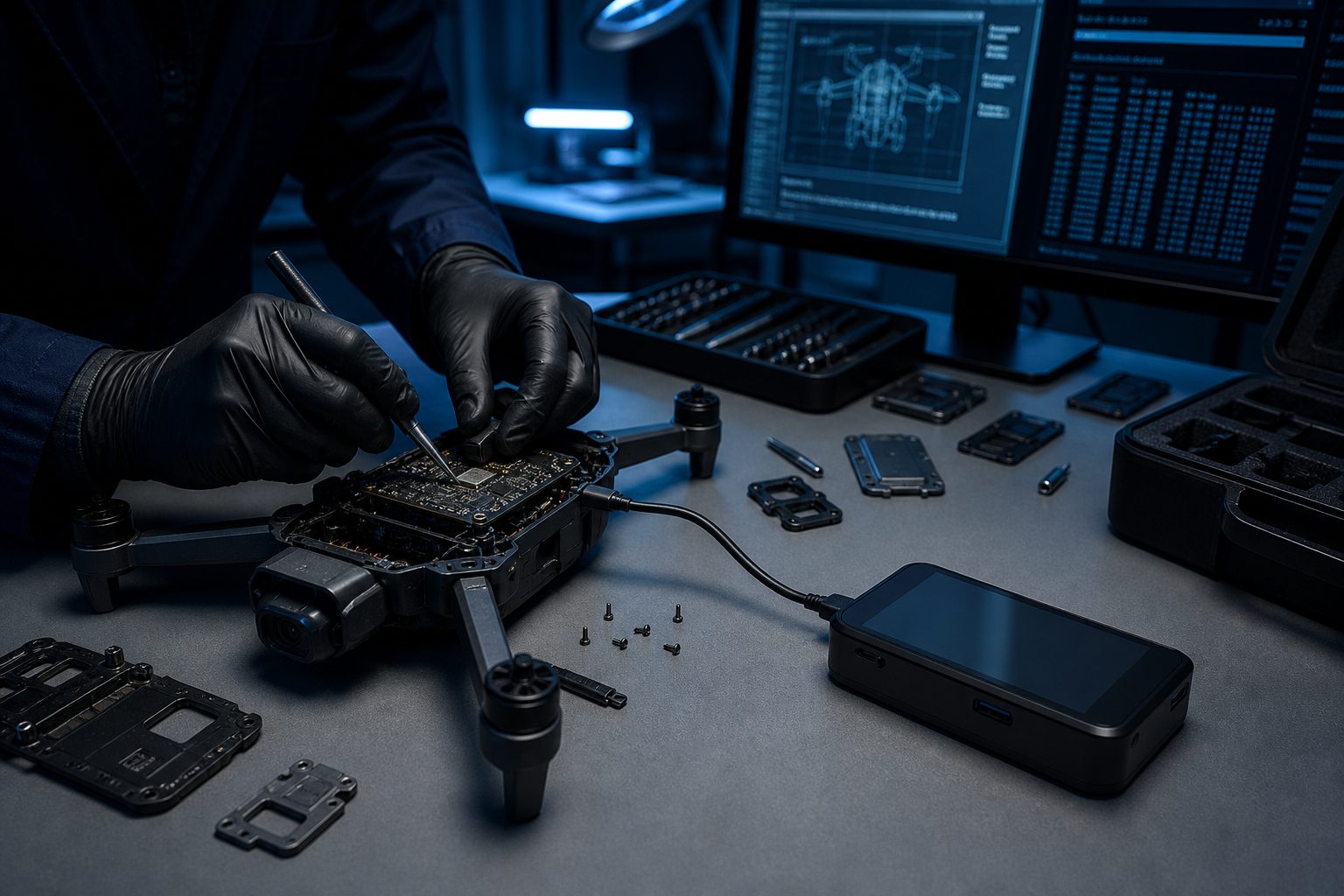
A Drone Forensics Operation at Scale: 1,200+ UAVs. Nearly 10 TB of Data. One CFID.
Gaurav Rajput, a Scientific Officer specializing in Drone Forensics and Cyber UAV Intelligence in India, used Cellebrite’s CFID (Covert Forensic Imaging Device) to process more than 1,200 UAVs and extract nearly 10 TB of drone-related data across law enforcement and counter-drone use cases over two years. The cases demonstrate how a single field-ready forensic device can scale to meet the full volume and complexity of an operational drone intelligence workload — without lab dependency.
The Challenge
Drone forensics is no longer a niche capability. Drone forensics — the extraction and analysis of flight logs, GPS telemetry and onboard media from recovered UAVs — enables investigators and field operators to identify operators, reconstruct flight paths and generate actionable intelligence outputs. As UAVs become standard tools for criminal organizations, smuggling networks and hostile actors, the volume of drone-related cases is growing faster than most agencies can process. For specialists working across multiple agencies and operational environments, the bottleneck is not motivation or expertise. It is infrastructure.
Traditional digital forensics workflows were built for labs, not field environments. They require connectivity, specialized hardware and lengthy processing pipelines that were never designed to keep pace with UAV-related incidents. When a drone is recovered, the intelligence window is short. Flight logs, GPS telemetry, operator linkage and media evidence begin losing operational value the moment a device sits idle in an evidence queue.
Gaurav Rajput, Scientific Officer specializing in Drone Forensics and Cyber UAV Intelligence, needed a tool that could process a high volume of diverse UAV hardware at operational tempo without sacrificing the output quality required to support forensic reporting, technical analysis and field-support use cases across multiple agencies in India.
The Solution
Rajput integrated Cellebrite’s CFID into his drone forensics workflow alongside custom scripts and utilities developed for his operational environment. Over two years of extensive use, CFID became the primary extraction and decoding platform for a caseload that grew to include UAV examinations across law enforcement investigations, counter-drone support and field-based technical assessments.
“CFID has become an important part of our drone forensics workflow. It has helped us process a large number of drones, extract usable data at scale, and turn recovered drone hardware into actionable technical outputs.“
— Gaurav Rajput, Scientific Officer, Drone Forensics and Cyber UAV Intelligence, India
Where standard extraction workflows fell short on more technically complex UAV hardware, Rajput found that CFID’s support resources and direct engagement with Cellebrite filled the gap. The result was a workflow capable of handling both routine case volume and higher-complexity extractions within the same tool and operational framework.
The Results
Over two years of operational use, Rajput processed more than 1,200 drone cases using a single CFID unit, extracted nearly 10 TB of drone-related data and completed 800+ successful extractions producing usable, operationally meaningful outputs, demonstrating what field-ready drone forensics capability looks like at scale.
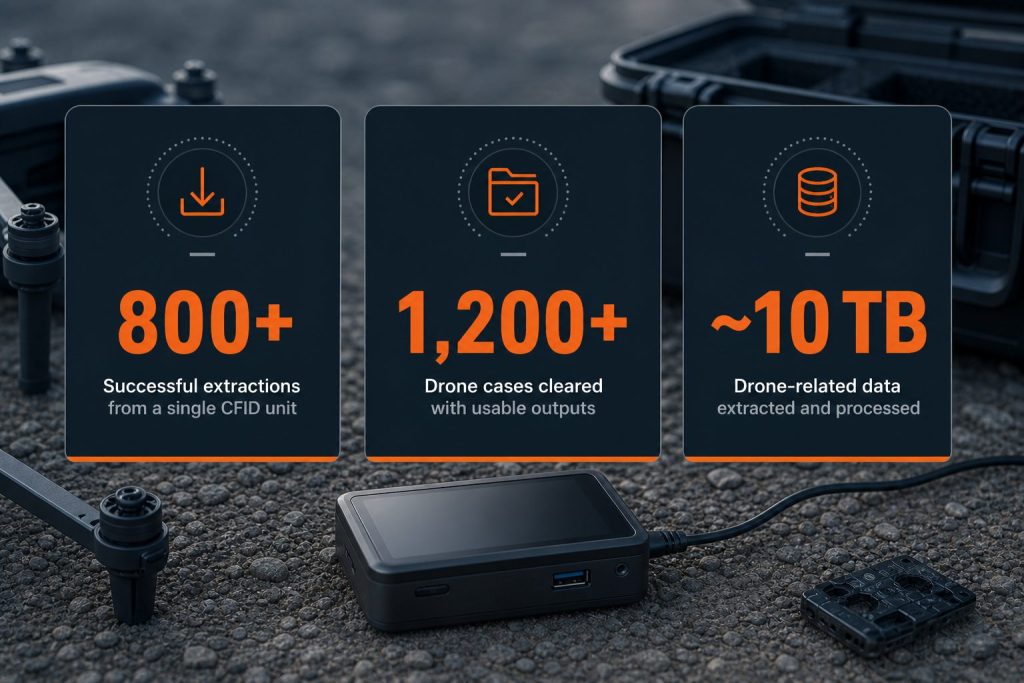
The figures represent successful extractions producing usable, operationally meaningful outputs — not merely attempted processing. Total drone and dataset handling volume runs approximately 1.4 times higher when including attempted, partial, triage and non-reportable processing.
Drone recovered from a sensitive or restricted area: CFID enabled rapid technical assessment to determine whether a recovered UAV contained usable flight records, media or device identifiers. This reduced the time required to understand the device’s likely purpose and activity, and helped investigators decide whether further examination was warranted.
Counter-drone and field-support workflows: In field-support scenarios, fast access to extracted drone data helped teams characterize the platform, understand usage patterns and operator behavior, and evaluate technical configuration. CFID-generated outputs supported operational planning, threat assessment and post-incident review.
“In our environment, the combination of CFID, Cellebrite support, and our own custom utilities has significantly improved speed, consistency, and operational value across forensic and selected field-support use cases.”
— Gaurav Rajput, Scientific Officer, Drone Forensics and Cyber UAV Intelligence, India
See What Cellebrite Drone Forensics Can Do for Your Agency
Rajput’s results reflect what becomes possible when agencies and specialists have field-ready forensic capability that keeps pace with the volume and complexity of today’s UAV threat. Whether your mission is building a prosecution-ready evidence package, supporting counter-drone operations or processing drone hardware at scale, Cellebrite gives your team the tools to turn a recovered drone into actionable intelligence.