
Deterrence through Collective Digital Intelligence
Intelligence is the foundation of deterrence. Cellebrite helps allies extract and share critical information, for decision advantage against active threats.
The threat is present, not hypothetical
For nations on NATO’s eastern flank, the question is not whether Russia poses a threat, it is how to operate effectively under one that is already active. Hybrid operations, persistent border pressure and the deliberate targeting of allied unit cohesion are ongoing. Enemy intelligence units are operating in border regions now, methodically degrading situational awareness and exploiting the gaps between allies before any formal threshold is crossed.
Incursion scenarios, such as into Poland and the Baltics, are not abstract planning exercises. They are contingencies allied forces are postured against today. Deterrence in this environment depends not only on presence and firepower, but on the quality and currency of a shared intelligence picture.
Why collective intelligence matters
Russia’s approach to competition is deliberate. It targets the seams, whether between nations, between commands or between collection and action. When allied intelligence remains siloed and extraction at the tactical edge fails to feed rapidly into a coalition-wide picture, those seams remain exploitable.
The gap between what one ally knows and what another can act upon is not an administrative inconvenience. It is a structural vulnerability that adversaries are specifically organised to find and widen.
The Cellebrite workflow: from device to decision advantage
1. Rapid digital exploitation at the point of collection
When forces encounter digital devices in the field, including drones, mobile phones, computers and other collected exploitable material (CEM), the intelligence window is narrow. Delays in accessing devices or sifting through data to reach critical information can cost lives.
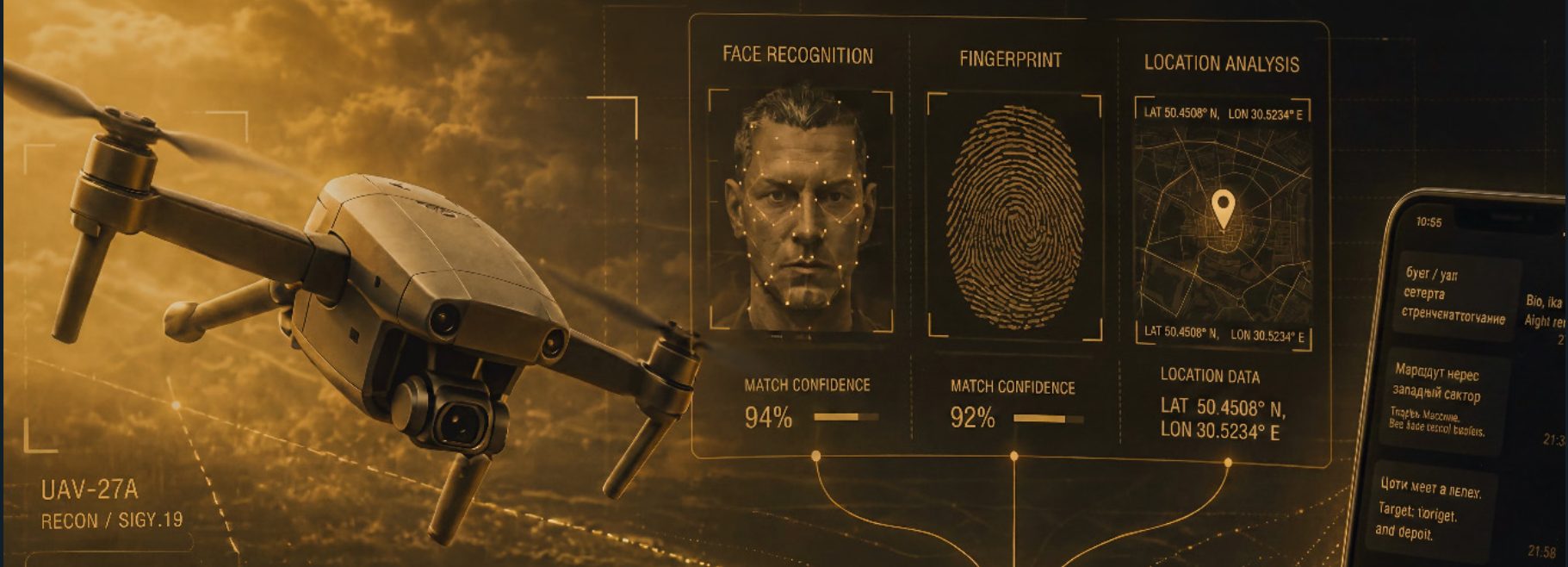
Cellebrite’s Inseyets platform enables rapid triage, extraction and exploitation at the point of collection across the full range of human signature digital identity and exploitation missions — sensitive site exploitation (SSE), document and media exploitation (DOMEX), cellular exploitation (CELLEX) — whether in the field, at a border checkpoint or on a covert operation. Using portable, ruggedised solutions, forces can quickly extract and surface device owners and faces, locations, fingerprints and communications of interest.
In the case of drones, Cellebrite Inseyets CFID traces flight paths back to their point of origin from the field. No fixed facility required, no connectivity dependency. Critical information is in analysts’ hands within minutes of recovery.
2. AI-powered identity and operational intelligence
The real value of digital data is in the aggregate. The ability to view identities and conversations from multiple devices on a single, unified timeline is powerful. The assistance of machine learning to automatically surface training locations, suspicious planning activity, maps of people of interest and how they are connected is operationally invaluable.
Cellebrite’s Pathfinder on-prem platform, deployable in forward operating bases, labs or on rolling servers at the frontlines, rapidly analyses hundreds of devices and massive datasets simultaneously to map threat networks, deanonymise device owners and surface associations that would not be visible from any single collection. Supporting the Find, Fix, Finish, Exploit, Analyse and Disseminate (F3EAD) targeting cycle, Pathfinder gives analysts and commanders a defensible understanding of the threat environment at the speed required for operational decision-making.
3. Secure sharing for a stronger operational picture
More intelligence means better planning. In NATO’s current operational environment, allies cannot afford to remain siloed. Instant, secure dissemination of data and intelligence enables all member nations to maintain full operational context and make clearer decisions at scale.
Through Guardian, Cellebrite’s secure cloud sharing platform, data is transmitted securely to allied commands and regional hubs, where partners correlate it with their own collection and contribute in return. What one nation’s forces recovered at the border becomes part of a continuously growing coalition picture. The alliance sees more because every member contributes to what all members can access.
4. Cyber operations research for resilience and reverse engineering
Modern conflict is conducted via an increasingly diverse and complex array of digital devices, from unmanned systems (UxS) to vehicles, mobile phones and even Internet of Things (IoT) devices such as smart watches and embedded equipment. All of these must be secured, and all represent potential data sources and attack vectors against adversaries. The challenge is modelling the devices to make the data usable.
Corellium, a Cellebrite product, dramatically enhances these capabilities. It provides cyber and mobile security units with a virtualised environment for deep device research and reverse engineering, enabling safe, thorough analysis of captured hardware and software without exposure to operational networks. Deployable on-premises within classified environments, Corellium ensures that the intelligence value of a recovered device can be fully exploited without the device exploiting the force in return.
Collective intelligence as a strategic capability
NATO’s deterrent posture is only as strong as the shared awareness that underpins it. In the current environment, where the competition and crisis phases are sustained rather than episodic, the ability to extract, analyse, share and secure intelligence at mission speed is a strategic requirement. The nations that share more see more. Those that see more act with greater confidence, greater coherence and greater effect alongside their allies.
From the edge to command. Share at mission speed.