
iOS Jailbreaking Is Over: What It Means for Your Security Team
New Apple iOS Releases end physical jailbreaking for good. Learn why Corellium is the only way to fully analyze and verify iOS internals, mobile app vulnerabilities and conduct mobile security research.
With the release of iOS 27, Apple has shut down the last viable way for security teams to perform deep, root-level security testing on iOS: the jailbreaks. For years, jailbreaks gave teams a way to inspect app behavior on real devices, not just in simulations or static code reviews.
Now that is gone. What Apple calls enhanced protection has created a new kind of risk: a total loss of visibility for developers, penetration testers and security leaders who need to understand how apps behave on real devices.
Organizations are no longer testing apps. They are testing assumptions.
TL;DR: iOS 27 cannot be jailbroken on any current physical device and there is no reliable public jailbreak for anything above iOS 18. Security teams that need root-level visibility now get it through virtualized iOS environments rather than physical jailbreaks.
Key Takeaways
Here’s what security and compliance teams need to know about the iOS 27 jailbreak shutdown and what comes next:
- There’s no reliable public jailbreak for any device running iOS 18 or above.
- Without jailbreak access, security teams lose root-level visibility into keychain data, live API calls, inter-app communication and kernel-level protections.
- Regulators – HIPAA, PCI DSS, GDPR, CCPA, DORA, NIS2, FISMA, and CMMC – still require verifiable evidence, so a testing gap quickly becomes a compliance gap.
- Fake jailbreak tools like nekoJB are circulating and often carry malware.
- Corellium’s virtual iOS environments are the only way to get root-level, real-firmware testing without relying on exploited vulnerabilities.
Runtime Validation Disappears With iOS Jailbreaks
Jailbreaks were never ideal, but they provided access to what mattered while making it possible to test how apps behaved inside the OS. With no public jailbreak for anything above iOS 18 – if we are being conservative – many teams are asking: Can you jailbreak new iPhones at all? The short answer is no, not reliably.
Here is what security teams lose without root-level access:
- Inspecting the keychain and local file storage
- Monitoring live API calls and runtime behavior
- Auditing inter-app communication and permissions
- Observing kernel-level protections in action
Simulators can’t fully reproduce the hardware-backed security controls, OS behavior or device conditions of a physical iPhone. Static analysis can’t confirm how an SDK behaves once the app is running. Older jailbroken devices support legacy research, but they don’t reflect the iOS versions customers are running in production.
The result is an incomplete view of risk: teams end up testing the code they can inspect, not how the app behaves once it’s running.
Jailbreaks Deepen the Compliance Evidence Gap
Regulators do not care what a test suite says. They care whether teams can prove their app handles sensitive data correctly on real devices and under real conditions. With iOS 27 locking out root-level testing, that proof becomes difficult or impossible. Security and compliance teams lose the ability to verify whether mobile apps meet even basic requirements for data protection.
Limited runtime visibility can make it harder to validate mobile security controls and produce evidence relevant to regulatory and assurance requirements.
In every case, compliance depends on verifiable evidence, not assumptions or trust. Apple’s closed ecosystem leaves organizations without an independent way to validate what is happening on iOS devices.
Global
- PCI DSS: Reduced ability to verify how payment account data is handled during application execution, including whether sensitive data is stored, transmitted, logged or exposed contrary to policy.
North America
- HIPAA: Difficulty confirming that electronic protected health information is appropriately protected when stored, cached, transmitted or removed by a mobile application.
- CCPA: Reduced visibility into how personal information is collected, disclosed or shared through embedded third-party technologies and whether that behavior aligns with consumer disclosures and service-provider restrictions.
- FISMA: Limited technical evidence for assessing security controls when a mobile application falls within the boundary of a federal information system.
- CMMC: Difficulty demonstrating implementation of applicable safeguards when mobile applications or devices process, store, or transmit Federal Contract Information or Controlled Unclassified Information.
Europe
- GDPR: Difficulty assessing whether personal data collection, sharing, retention and third-party processing within the mobile application align with documented purposes and data-protection requirements.
- DORA: Gaps in the evidence used by financial entities to assess and test the resilience of mobile applications that support important or critical business services.
- NIS2: Difficulty validating whether cybersecurity risk-management measures protecting mobile services operate effectively in practice.
Asia
- APRA CPS 234 (Australia): Difficulty demonstrating that information security controls protecting mobile banking channels have been systematically tested, with testing commensurate with the rate at which applications and threats change, and with evidence available for APRA review. CPS 230 extends the same scrutiny to operational resilience and third-party providers.
- MAS TRM (Singapore): Reduced ability to evidence the penetration testing, vulnerability assessment, and remediation follow-through the Monetary Authority of Singapore expects for internet-facing financial services, including after significant application or OS changes, under the TRM Guidelines and the Cyber Hygiene Notice.
- RBI Digital Payment Security Controls (India): Limited runtime evidence that payment and mobile banking applications meet the Reserve Bank of India’s security testing expectations, which apply before launch and periodically thereafter, including how payment data behaves inside the running application.
- FISC Guidelines (Japan): Difficulty producing the control-effectiveness evidence Japanese financial institutions rely on under FISC security guidelines, as FSA supervision extends into third-party and mobile channel risk.
- FSS Electronic Financial Supervisory Regulations (South Korea): Reduced ability to verify at runtime the security measures required of electronic financial services, and to support ISMS-P certification evidence for mobile services.
- OJK IT Regulations (Indonesia): Gaps in the testing evidence banks need under OJK’s IT risk management rules, including validation of mobile channel controls after each release.
- APAC privacy laws (DPDP Act in India, PDPA in Singapore, APPI in Japan, PIPA in South Korea, Privacy Act in Australia): Difficulty assessing whether personal data collection, sharing, and third-party SDK behavior inside the mobile application match what was disclosed to users and regulators.
The iOS Trade-Off: Visibility or Vulnerability
Every organization that ships iOS apps eventually faces the same decision: where do you draw the line on OS version support?
Most enterprise apps currently cover multiple versions, often iOS 15 through iOS 27. But that range introduces a painful trade-off.
Support older versions (iOS 15/16)
- Retain jailbreak access and system-level visibility
- Expose customers to known vulnerabilities actively exploited in the wild
Support only recent versions (iOS 17+)
- Shrink the attack surface by dropping legacy support
- Lose the ability to test how the app behaves on real devices
There’s no perfect answer, and whichever path a business chooses, it inherits risk. Older versions can be vulnerable to attacks, while security teams can’t verify that the app is fully compliant and secure on newer versions. While most organizations raise their minimum OS version to 17+, they often overlook losing visibility. Without real-world testing, even an app that passes all checks may carry hidden risk.
Hardcoded Secrets: A Costly Risk
When security teams lose visibility, sensitive data exposure becomes a silent risk. Hardcoded secrets are a common culprit.
In the 2025 Verizon Mobile Security Report, 85% of respondents acknowledged that mobile device threats are growing, and more than half had already experienced a mobile-related security incident. In the study of more than 156,000 apps, researchers also found:
- 71% of those apps contained at least one hardcoded secret, such as API keys, cloud credentials or encryption keys embedded directly into the code.
- Across those apps they uncovered 815,000 unique secrets, many linked to real production systems.
- Many secrets were invisible to static scanners and would likely not be caught by Apple’s review process.
This is not a theoretical flaw; it is a high-impact security risk hiding in plain sight. Without access to the app running in a real environment, there’s no way to confirm whether those secrets are accessible at runtime.
If credentials are exposed, attackers can exfiltrate customer data, move laterally inside enterprise environments or/and trigger compliance violations.
The Rise of Fake Jailbreak Scams
When security teams lose visibility, they also might go looking for another way in. This gap is exactly what scammers are counting on. Demand for jailbreaks is at an all time high and bad actors are cashing in.
With no reliable jailbreak left for current iOS versions, researchers and testers are pulled toward workarounds that only look like a path back to root-level access:
- Buying jailbroken iPhones from online sellers
- Attempting risky online jailbreak tools, such as the latest versions of nekoJB
- Installing payloads from message boards, social media or unofficial GitHub repos
Every one of these workarounds is short-lived and high risk:
- Jailbreaks do not work on iOS 17+
- Some tools are malware in disguise, injecting malicious code or creating supply-chain risk
- Even legitimate jailbreaks often lead to device instability, bricking or security compromise
The jailbreak era is over – but there’s still a safe, sustainable path forward: Corellium’s controlled iOS, iPadOS and Android environments give teams a faster route to validation.
Corellium Is the Only Access That Works
Corellium gives security teams access to virtual iOS and iPadOS that can be provisioned in jailbroken or non-jailbroken configurations, including root-level access for deeper inspection testing. It is the path forward for teams that need deep, root-level access to iOS and iPadOS.
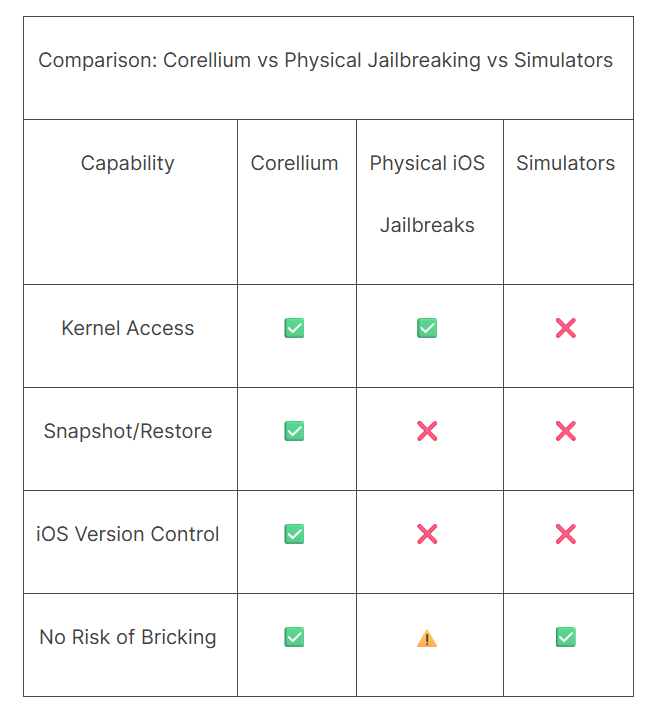
Unlike physical device jailbreaks, Corellium does not rely on exploited vulnerabilities to provide this level of access. Security teams and government agencies worldwide use Corellium.
- Analyze how apps behave at runtime including unrestricted file access, user and kernel memory access, keychain storage and inter-process communication.
- Inspect third-party SDK behavior while the app is running, not only what is declared statically.
- Run apps under real iOS conditions to observe what static tools and simulators can’t reveal.
- Reproduce issues tied to runtime state, not just source code bugs.
- Validate security and privacy controls as they execute, not only as written.
Want to learn more? Talk to our team about deploying Corellium.
Want the full regulatory breakdown and a step-by-step testing roadmap? See the Mobile Security Playbook for a guide to closing the iOS 27 jailbreak gap.
Frequently Asked Questions
Can iOS 27 be jailbroken?
No. There is no public jailbreak for iOS 27 on any current physical device — conservatively, nothing above iOS 18 has a reliable public jailbreak. Tools circulating online that claim to jailbreak iOS 27 are often malware in disguise.
Is it safe to jailbreak an iPhone in 2026?
No safe or sustainable jailbreak path remains. Jailbreak tools shared online are short-lived and high risk. Some inject malicious code or create supply-chain risk, and even legitimate jailbreaks can cause device instability, bricking, or security compromise.
What do security teams lose without jailbreak access?
Root-level runtime visibility: inspecting the keychain and local file storage, monitoring live API calls and runtime behavior, auditing inter-app communication and permissions and observing kernel-level protections in action.
How can teams test iOS apps without a jailbreak?
Virtualized iOS devices running real firmware, such as Corellium, provide controlled root-level access to current iOS and iPadOS versions without relying on exploited vulnerabilities, so teams can validate runtime behavior and compliance controls.


