

The Access Gap Is Closed: What Cellebrite Can Unlock in 2026
Key Takeaways
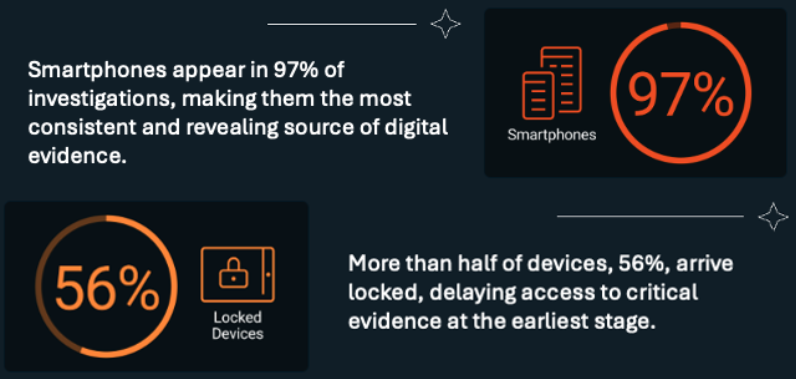
- 56% of devices arrive locked, creating a bottleneck at the first step of every investigation. The forensic tool an agency selects directly determines what evidence makes it to court.
- Cellebrite Inseyets now offers the broadest device access on the market, covering the latest iOS (AFU and BFU), Android full file system extraction, field-ready kiosk collection and drone forensics via CFID.
- Access alone is not enough. Cellebrite’s platform connects extraction to AI-powered analysis in Physical Analyzer and secure evidence management in Guardian, running the full chain from locked device to court-ready report.
- More than 7,000 agencies trust Cellebrite, running nearly 3 million investigations per year across virtually every device type, OS version and investigative scenario.
For years, one of the most common questions in digital forensics procurement sounded something like this: “But can it get into that iPhone?”
It was a reasonable question. The ability to access a locked device — to get past passcodes, encryption and the ever-tightening security layers built into modern iOS and Android operating systems — has long been the defining capability that separates useful forensic tools from great ones. And for a period, the honest answer was that the market was genuinely competitive. Some tools were better on iOS. Others led on certain Android models. No single solution held a decisive advantage across the board.
That period is over.
In 2026, Cellebrite has pulled ahead meaningfully in the capability that matters most: getting access to the devices investigators actually encounter in the field.
Why Is Access to Locked Devices So Difficult in Digital Forensics?
Before getting into what’s changed, it’s worth acknowledging why device access is so difficult in the first place.
Modern smartphones are extraordinarily good at protecting the data on them. Apple’s Secure Enclave architecture, Google’s Titan M security chips and the proliferation of complex alphanumeric passcodes have made brute-force approaches increasingly impractical. The stakes are high too: according to Cellebrite’s 2026 Industry Trends Report, 97% of investigators now cite smartphones as the leading source of digital evidence — up 24 points from 73% just two years ago. At the same time, more than half of all devices (56%) arrive locked, creating a bottleneck at the very first step of the investigation.
When a device can’t be accessed, cases stall. Examiners send devices to state labs or specialized services, waiting weeks or months for results. Investigators move forward without critical evidence. Prosecutors build cases on incomplete information.
The question of which tool can get into which device isn’t academic. It directly determines what evidence makes it to court.
How Do Digital Forensics Tools Compare in Accessing Locked Devices?
A select few competitors have built a strong reputation specifically in iOS unlocking. Their marketing claims same-day access on iOS and leading Android devices, and their customer testimonials emphasize speed. On their own websites, they note that surveyed users cite access within hours as the primary reason they selected the tool.
That’s a real capability, and it reflects genuine investment. The digital forensics market has benefited from having more than one serious contender pushing device access forward.
But their solutions operate as a standalone access tool of a larger puzzle. Agencies that use it still need separate solutions to process, analyze and manage what they extract. And critically, the competition platform offerings lack the breadth of integration that today’s investigations demand. Accessing a phone is only step one.
What Can Cellebrite Inseyets Access in 2026?
Cellebrite’s Inseyets platform now offers what is widely regarded as the most comprehensive device access available on the market.
Here’s what that looks like in practice in 2026:
iOS: Cellebrite supports access to the latest iPhone models and iOS versions, including both after-first-unlock (AFU) and before-first-unlock (BFU) states. Recent updates have introduced new AFU access methods for previously unsupported iOS device configurations, expanding the range of devices that can be accessed without requiring a prior unlock event.
Android: The latest releases restored and expanded full file system (FFS) extraction across a broad range of newer Android models, which is an area where the competitive landscape had seen fluctuation. Coverage now spans Samsung, Google Pixel and other major Android manufacturers at their current OS versions.
Field-ready access: With the addition of the Cellebrite Kiosk, frontline teams can now extract, triage and collect data outside the lab without requiring specialized forensic training. This brings access out of the dedicated forensics environment and into patrol vehicles, command posts and border crossings.
Drone forensics: In March 2026, Cellebrite completed its acquisition of SCG Canada, adding handheld drone forensics capability through the CFID (Covert Forensic Imaging Device). The CFID enables rapid extraction, decoding and visualization of data from more than 80 common UAV models at the point of collection, including flight logs, GPS coordinates, video footage and more. This is a category that competitors do not have. And with Congress having passed the SAFER SKIES Act in December 2025 – expanding counter-UAS authority to state, local and correctional agencies for the first time – drone forensics is becoming operationally relevant for law enforcement at every level.
Why Unlocking a Device Doesn’t Close the Case
It’s worth making a point that is easy to miss when evaluating access tools in isolation: accessing a device is the beginning of an investigation, not the end of it.
How you process, analyze, collaborate around and present the data you extract determines whether that access translates into a closed case. This is where the framing of “access only” tools starts to show its limits.
Cellebrite Inseyets is not just an extraction tool. Once a device is accessed, Physical Analyzer processes and surfaces the data — deleted files, encrypted content, media, communications — and AI-powered capabilities in the latest release include automatic content classification, identification of AI-generated media modifications and on-demand speech-to-text transcription in over 60 languages. With the capability to have extracted data flow directly into Cellebrite Guardian for secure evidence management, review and cross-agency collaboration. The full chain runs through a single platform, from locked device to court-ready report.
Agencies that rely on multiple point solutions — one tool for access, another for analysis, a third for review — introduce gaps at every handoff. Gaps in chain of custody. Gaps in workflow efficiency. Gaps in the completeness of the investigative record.
What 7,000+ Agencies Have Figured Out
More than 7,000 law enforcement agencies, defense and intelligence organizations and enterprises worldwide trust Cellebrite’s platform. Those agencies run nearly 3 million investigations per year on it.
That scale of adoption isn’t just a marketing stat. It reflects the confidence that comes from a platform that has been tested across virtually every device type, operating system version and investigative scenario that exists. It reflects continuous investment in R&D which delivered expanded device access while simultaneously delivering new AI capabilities, cloud infrastructure and field-ready workflows. It reflects a commitment to staying ahead of device manufacturers as they harden their platforms, not playing catch-up.
Lt. Travis Lavergne of Calcasieu Parish Sheriff’s Office put it simply: “We’ve gone from a six-month turnaround to three weeks. That’s a huge win for our community and for the victims waiting for justice.” –> Read the Calcasieu Parish story
Is Cellebrite the Best Digital Forensic Tool for Locked Devices?
If your agency is still running a device access evaluation, the landscape has changed enough in the last 18 months that previous conclusions may no longer hold. The combination of Cellebrite’s latest iOS and Android access capabilities, the new field-ready extraction options in Inseyets and the addition of drone forensics puts Cellebrite in a category of its own — not just for access, but for the end-to-end workflow that begins the moment a device is seized.
The access gap has closed. The question now is whether your agency is ready to take advantage of it.
Frequently Asked Questions
What percentage of devices arrive locked at forensic labs?
According to Cellebrite’s 2026 Industry Trends Report, more than half of all devices (56%) arrive locked. In North America, that figure reaches 75%. This creates a bottleneck at the very first step of the investigation, making the choice of forensic tool for locked devices a critical procurement decision.
What is the difference between AFU and BFU device access?
AFU (after-first-unlock) refers to a device state where the phone has been unlocked at least once since its last power-on, meaning encryption keys are available in memory. BFU (before-first-unlock) is the more restrictive state where the device has not been unlocked since boot and most user data remains encrypted. Cellebrite Inseyets supports access in both AFU and BFU states for the latest iPhone models and iOS versions.
Can Cellebrite extract data from drones?
Yes. Following its March 2026 acquisition of SCG Canada, Cellebrite offers drone forensics through the CFID (Covert Forensic Imaging Device). The CFID enables rapid extraction, decoding and visualization of data from more than 80 common UAV models at the point of collection, including flight logs, GPS coordinates and video footage. This capability is not available from competing forensic device access providers.
What happens after a locked device is accessed?
Once a device is accessed, the extracted data must be processed, analyzed and managed before it becomes court-ready evidence. With Cellebrite, Physical Analyzer handles decoding and AI-powered analysis — including automatic content classification, detection of AI-generated media modifications and speech-to-text transcription in over 60 languages. Extracted data then flows into Guardian for secure evidence management, review and cross-agency collaboration. Agencies that use standalone access tools must stitch together separate solutions for each of these steps, introducing gaps in chain of custody and workflow efficiency.