

‘It Was a True Gangster’s Paradise:’ Mississippi DPS Uses Technology to Unravel Prison Criminal Enterprise
In early January 2020, there had been days of prison riots which resulted in multiple inmates dead at the hands of other inmates at the Mississippi State Penitentiary at Parchman. In the chaos, two inmates escaped, which sparked a manhunt.
On January 4, Wayne Cantrell, Director of Digital Forensics at the Mississippi Department of Public Safety (MSDPS) got an urgent assignment.
“I was literally taking a Christmas tree down,” says Cantrell. “Director (Jimmy) Herzog called me and said I need you to head to the [Mississippi] Delta to Parchman.”
The escaped inmates had stolen a truck and left the prison grounds. They did not get far. The four-wheeler runs out of gas, and left a jacket behind. In the pocket was a phone.
A field agent handed the phone to Cantrell, took custody of it and carried it to the original lab MSDPS started in 2018. He got to work with Cellebrite technology.
“I was able to do an emergency download on the device and get a full file system extraction with Cellebrite,” says Cantrell. “It was clear that I had the whole gangster network in front of me.”
The moment was surreal for Cantrell. He pushed back from the table, took a breath and thought about his next steps: “I’ve got to get this in somebody’s hands where we can act on this.”
Violence Behind Prison Walls
The urgency was real: inmates were dying, and the staff were in danger.
“The hardest part was that people were actually getting hurt,” says Lt. Col. Jimmy Herzog, the Deputy Commissioner and Director of the Mississippi Bureau of Investigation. “People are dying here and inmates are not safe. Staff is not safe.”
Regular corrections officers have stopped coming to work. “It was out of control,” Herzog says.
The investigation grows complex and fast, with multiple people, witnesses and more devices than they can count. Something dawns on the team.
“We’ve pretty much come to the conclusion that you’re not going to be able to solve crimes in the future without digital forensics,” says Jim Brison, Director of the Mississippi Office of Homeland Security.
More than a Thousand Devices Full of Evidence
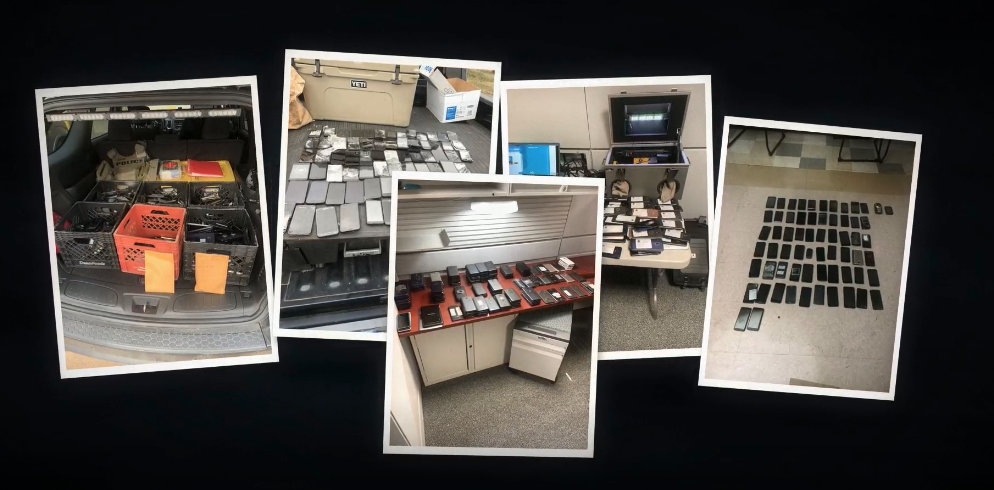
Investigators collect devices in correctional facilities from the north end of the state to the south. The total reached 1,137.
“When I walked into Wayne’s office and saw banker box after banker box after banker box of cell phones, my first thought was, how do you go through hundreds of cell phones,” Brinson asked.
The volume of data raises a real question. “At first we were not sure how we were even going to handle that much data,” Cantrell explains.
Help arrived via a phone call.
“I received a call from Secret Service saying, look, Cellebrite has got wind of this case and they have a great system and they’re willing to come set up a server and facilitate your investigation,” Cantrell explains.
Pathfinder Maps the Network
As a proof of concept, the team turns to Cellebrite Pathfinder, an AI-powered cross-case, multi-device analysis solution that can ingest up to about 2,000 devices.
“I was able to ingest that into Pathfinder and it labeled the whole hierarchy from here to Chicago,” says Cantrell. “That was a moment where I’m like, OK, we’re going to make it through this.”
Pathfinder connects phones to people and people to each other, and a structure emerges. The speed matters as much as the clarity.
“The amount of deconfliction that we did, in that short amount of time, we could not have humanly done it,” shared Cantrell.
Inside the Enterprise
The picture that emerges is of an organization run with discipline.
“They’re very organized in the way they communicate,” explains Cantrell. “They use more discipline with their chain of command than most [Fortune] 500 companies.”
The network reaches far beyond one prison. “If it could be trafficked, they’re doing it, and there’s a digital footprint for that.”
The data also shows how far the network goes to protect its own interests. “They were extorting families basically to have their loved one moved to another prison system just to facilitate a murder,” says Cantrell.
The team reaches its conclusion: “We determined it was a paradise for inmates… a gangster’s paradise,” says Herzog.
Gangster’s Paradise Sparked a Change in How MSDPS Works
The results change how MSDPS works every day. Large collections of intelligence do more than close one case, it can inform others.
“Anytime there’s a large amount of Intel that’s gathered like that, we want to be able to get access to that information because it may actually help me in other crimes that other agencies are looking at, or it may actually help me stop something in the future,” says Lt. Col. Phillip Pope, Chief of the Mississippi Bureau of Narcotics.
“We looked at what we were able to accomplish through Gangster’s Paradise and say, hey, we need these systems on a daily basis,” adds Brinson.
Every unit in Mississippi DPS now work together to purchase the equipment and training investigators need. They use Cellebrite’s portfolio of solutions to access, collect, analyze, manage and share the investigative data with the prosecutor’s office and the case agent.
“Now we support every agency in our area, even the federal agency,” says Cantrell. “Some of the things that we’re putting together here, I think we’ll be a model elsewhere.”
Justice Served
Pairing traditional investigative work with digital forensics changes the outcome. “We can actually solve more cases and keep people safe,” says Herzog sharing that without it, the story could have ended very differently “We would probably still be wondering how this actually happened, what took place, and then obviously the people that did this justice probably would not have been served.”
The message to Herzog has for perpetrators is direct. “If you’re utilizing digital evidence as far as committing a crime, you will be caught, I can assure you of that.”
The U.S. Department of Justice investigated and found that conditions at the Mississippi State Penitentiary violated the U.S. Constitution, prompting statewide reforms.